
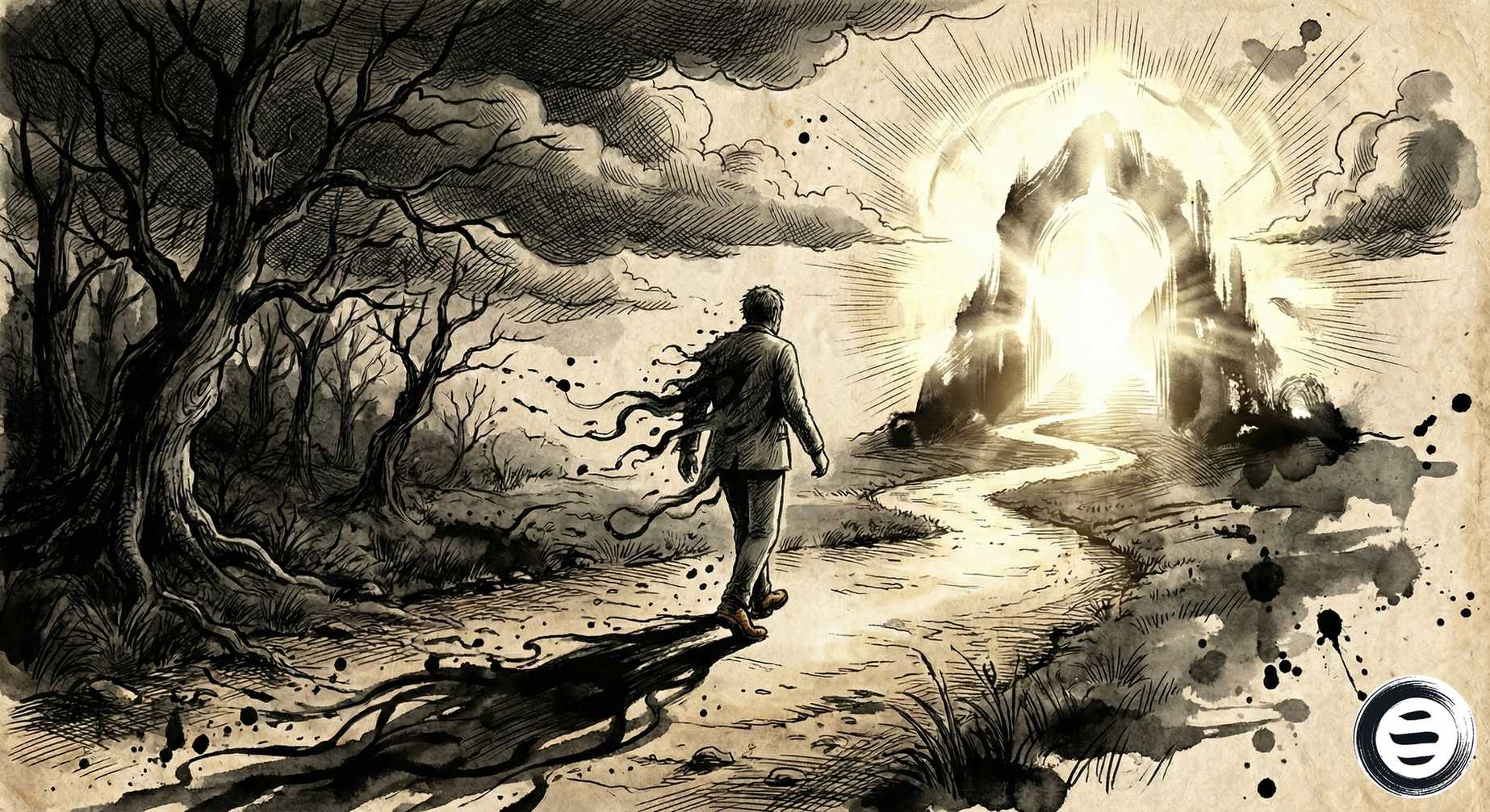
Closed Doors
Imagine living for years in a house with dozens of rooms, yet using only one—never opening the doors to any others since you first arrived. You stick to the room initially shown to you, finding it safe, and secretly worry about what might lurk in those other rooms, afraid to open the doors.

Imagine living for years in a house with dozens of rooms, yet using only one, never opening the doors to any others since you first arrived.
You stick to the room initially shown to you, finding it safe, and secretly worry about what might lurk in those other rooms, afraid to open the doors.
Every one of us has such doors inside us, doors we don’t want to open or face, because behind them lie our questions, fears, negative emotions, unhappiness, and nagging worries that what we think we know might be wrong.
Even if we act as though those doors don’t exist, they’re there. The longer we avoid opening them or shining a light inside, the deeper our anxiety grows. Yet paradoxically, this anxiety convinces us all the more to keep them shut. And so we become ever more dependent on the one room we do know, the room we call “safe,” even if we don’t truly enjoy being there.
That these doors have remained closed from the very beginning is closely tied to our ingrained conditioning inherited from family, society, culture, religion, and various other sources, conditioning that we’ve never truly confronted or questioned. Underlying that conditioning are our fears of rejection, exclusion, and not being accepted, as well as our search for identity and meaning.
This inherited set of beliefs, judgments, and thoughts about what is right or wrong, true or false, or who’s correct or mistaken, ideas we’ve never really questioned, offers us a sense of identity, along with an assurance of acceptance by society (or at least by a sufficiently large segment of it that allows us to feel adequate). That kind of security can be very hard to let go of.
Deep down, we know that these beliefs and judgments won’t bring us the answers or satisfaction we seek. But in most cases, we spend our lives convincing ourselves that they are indeed correct and that there’s no need to question them.
We consume sources that reinforce the same ideas, make friends with people who share those ideas, and thus reassure ourselves through the safety of belonging to a group that thinks alike. In doing so, we repress our desire to ask questions.
Gradually, we become people who have fixed opinions on right and wrong, who can offer ready-made answers to every question, but who have never faced their own questions. We become what society wants, yet fail to become truly human. We lose the chance to explore the deeper meaning of our existence.
Before long, our life turns into trying to fit square pieces into round holes, patching a torn piece of fabric with a different patch each day.
Because life changes, we constantly face evidence that our judgments might be off the mark, but we can’t bring ourselves to let them go. We become more rigid, more lacking in empathy, and more ruled by fear and anxiety.
It’s crucial to recognize that a truth we haven’t experienced for ourselves can never be truth in a profound sense, and therefore cannot give us authentic happiness or satisfaction, or that deep sense of “home” we’re all searching for.
Instead, we look for ourselves in secondhand experiences we’ve inherited and never questioned, which means we can’t possibly find the answers. We’re simply unwilling to accept the risk of setting off on our own quest. On one hand, we have the familiar set of beliefs we inherited, ones that provide an identity, even if we’re never truly happy with them, while on the other hand lies an uncharted path, one we can’t predict.
The idea of that unknown path frightens us. Yet we’re already living in fear: fear of rejection, judgment, exclusion, and losing our sense of worth. Our acceptance by society (or the group we move in) and our sense of value hinge on thinking and living as “they” do, playing that game where “the blind lead the blind” and affirming others so they affirm us in return.
The reality is, we don’t have to adopt any particular identity or view or sense of belonging.
We belong to life itself, to this world, to the universe, to the whole of existence. Anything that appears and disappears, that is here today and gone tomorrow, cannot define our true identity.
We need no identity beyond existing and being aware of our existence, because everything else is contrived and transient.
What we must do is acknowledge that voice inside us, the one conditioned by fear, that insists we continue playing the same game. Then we must choose to stop listening and begin truly living instead.


Comments